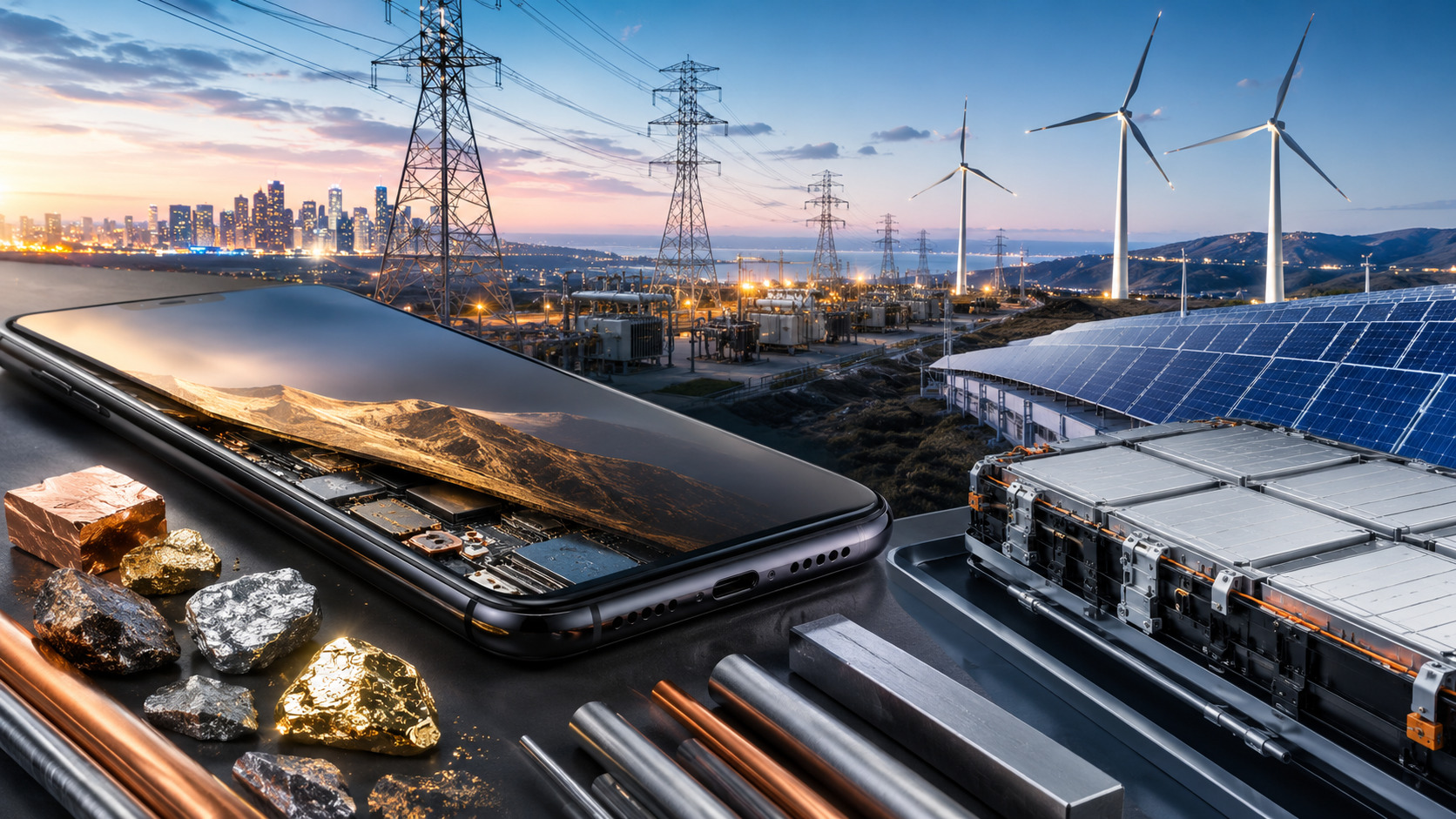
Modern life depends on materials that most people rarely think about. Smartphones, laptops, vehicles, medical equipment, power grids, solar panels, wind turbines, communication infrastructure, and even much of the equipment used in hospitals all rely on metals and mineral resources.
These materials do not simply appear inside modern technologies. Before becoming part of electronics, cables, batteries, medical devices, or industrial equipment, mineral resources undergo a long journey—geological exploration, resource evaluation, mining, processing, quality control, transportation, manufacturing, and eventually recycling.
For this reason, today’s discussion about the mining industry cannot remain confined to outdated perceptions or one-sided narratives. It must instead focus on the modern economy, technological independence, European competitiveness, responsible management of natural resources, and regional development.
The Invisible Foundation of Everyday Life
Metals are everywhere around us, even when we do not notice them.
A single smartphone contains dozens of different metals that make it lightweight, compact, fast, and highly functional. According to the European Commission, a smartphone may contain up to 50 different types of metals that contribute to its size, weight, and performance.
In healthcare, metals are essential for manufacturing diagnostic equipment, surgical instruments, implants, electronic monitoring systems, laboratory equipment, and advanced medical technologies. In transportation, they are used in vehicles, railway infrastructure, electrical systems, batteries, sensors, and communication modules. In the energy sector, metals are indispensable for cables, transformers, power grids, renewable energy installations, energy storage systems, and electrification.
This means that modern society cannot function without reliable access to metals and mineral resources. The question is no longer whether society needs them, but how they can be explored, extracted, and managed responsibly.
Europe Places Raw Materials at the Heart of Its Industrial Strategy
In recent years, the European Union has increasingly recognized raw materials as a strategic priority within its industrial policy. The reason is straightforward: without raw materials there can be no energy transition, no digital transformation, no advanced manufacturing, no defence resilience, and no competitive economy.
The European Commission defines critical raw materials as those with both high economic importance and a high risk of supply disruption. These materials are essential for numerous strategic sectors, including renewable energy, digital technologies, aerospace, defence, automotive manufacturing, and electronics.
Through the European Critical Raw Materials Act, the EU has established concrete objectives for 2030: at least 10% of the EU’s annual consumption of strategic raw materials should be extracted within the Union, at least 40% should be processed within the EU, at least 25% should come from recycling, and dependence on any single third country for an individual strategic raw material should not exceed 65%.
This clearly demonstrates that Europe no longer views raw materials as a peripheral issue but as a cornerstone of its economic and technological security.
Bulgaria Has an Important Role to Play
Bulgaria has a long tradition in geology, mining, and metallurgy. The country possesses valuable expertise, experienced professionals, established traditions, and significant geological potential that deserves to be assessed using modern methods and transparent regulatory frameworks.
For Bulgaria, the issue of metallic mineral resources has several important dimensions.
First, it is an economic opportunity. The responsible development of metallic mineral projects can generate significant investment, employment, local procurement opportunities, public revenues, and sustainable regional economic growth.
Second, it is an industrial opportunity. If Europe intends to reduce its dependence on external suppliers, Member States must understand and responsibly manage their own geological potential. Bulgaria should not remain solely a consumer of technologies manufactured elsewhere using resources extracted elsewhere. Instead, it can become an active participant in Europe’s raw materials and industrial value chain through exploration, mining, processing, engineering expertise, and a highly skilled workforce.
Third, it is a regional development issue. In many parts of Bulgaria, new investments in the real economy can create jobs, encourage people to remain in their local communities, and support local businesses. This is particularly important for municipalities with limited economic opportunities, where a responsibly developed project can deliver lasting benefits.
Metals and the Energy Transition
Public discussions frequently focus on renewable energy, electric vehicles, batteries, solar technologies, and digital innovation. Less frequently acknowledged is the fact that every one of these technologies depends on physical materials.
The International Energy Agency (IEA) emphasizes that minerals are fundamental components of rapidly expanding clean energy technologies—from wind turbines and electricity networks to electric vehicles. According to the IEA, demand for these minerals will continue to grow significantly as the global energy transition accelerates.
As society pursues greater electrification, cleaner technologies, and modern infrastructure, reliable, transparent, and sustainable supply chains for raw materials become increasingly important.
Recycling is an essential part of the solution, but it cannot by itself replace the need for primary raw materials, particularly while demand continues to grow and a substantial share of materials remains locked within products, infrastructure, and equipment that have long service lives. A truly sustainable approach therefore requires a balanced combination of exploration, mining, processing, reuse, recycling, and responsible waste management.
Why Responsible Mining Is Part of the Solution
Modern mining cannot operate without high environmental, technical, and social standards. Society has every right to expect transparency, effective oversight, public access to information, protection of water resources, responsible waste management, land rehabilitation, and tangible benefits for local communities.
This is precisely what distinguishes outdated perceptions of mining from the modern European approach to natural resource development.
Responsible mining does not mean unconditional approval of every project. It means clear regulatory procedures, expert assessments, public participation, institutional oversight, implementation of best practices, and a commitment to evaluating projects throughout their entire life cycle—from exploration to final site rehabilitation.
In this context, Europe’s raw material independence cannot be achieved through political declarations alone. It requires real projects, real investment, advanced technologies, and meaningful dialogue with society.
The Context of Tintyava Exploration AD
Tintyava Exploration AD is a geological exploration company focused on identifying and developing deposits of metallic mineral resources and critical elements. The company combines international and Bulgarian professional expertise, technical excellence, and a responsible approach to the development of mineral resource projects in Bulgaria.
The company’s flagship initiative is the Rozino Project—an investment proposal for the extraction and processing of polymetallic gold-silver ores from the Rozino deposit within the Tintyava exploration area, located in the Municipality of Ivaylovgrad.
The project should be viewed within the broader context of Bulgaria’s and Europe’s need to better understand and responsibly develop their geological potential. Gold and silver are part of a wider group of metallic raw materials that play an essential role in industry, electronics, advanced technologies, and the modern economy.
Conclusion
Metals are the invisible foundation of modern life. They are embedded in our technologies, infrastructure, healthcare, energy systems, transportation, and industry. Without them, there can be no digital economy, no energy transition, and no competitive industrial future.
For Bulgaria, this represents an opportunity to develop its geological potential responsibly, transparently, and sustainably. For local communities, it offers prospects for investment, employment, education, and long-term regional development. For Europe, it is an essential step toward greater industrial resilience and strategic autonomy.
For Tintyava Exploration AD, the Rozino Project forms part of this broader conversation—a conversation about natural resources, modern technologies, responsible development, and the future of the Municipality of Ivaylovgrad.